
I remember the first time I read how the second year of widowhood tends to be harder to get through. I was a few months into widowhood at that point. First, I was like why the F would you be telling me that?! Second, I didn’t believe it. The world likes to tell us there’s nice neat timelines on grief, so I’d be all healed up by then. Plus I was pretty sure I couldn’t handle worse. Things were already terrible.
But, retrospectively, that was when I was still in shock. When I read that warning about what was to come, I was still holding together our life. I was muddling through until Tom could come back. This couldn’t have actually happened, so soon we’d be back to being “the herd” as Tom called us. Soon we would be swapping stories about this weird time we had to get through.
When I think back I can see sort of phases to my grief journey so far – they are by no means linear (lots of back and forth) and I really haven’t been able to identify a phase until I’ve moved onto the next one.
Note – The “Stages of Grief” that we all somehow have heard about are out. Turns out they are based on research of what terminally-ill people go through when they themselves are about to die. So sure maybe some pieces come through in grieving, but there’s a movement now to get away from these expectations. The things I’ve learnt while reading/listening to all kinds of grief resources!
In the early days I often felt like I was floating. Sometimes this felt quite literal. The day I left Tom at the hospital for the last time, it was like I left my body too. He had already been pronounced dead, but for a day he still very much looked like my Tom as he lay there for all the organ testing. There’s a fogginess of at what point he was really gone. The night I left for the last time, I left what still looked exactly like my strong husband destined for the OR for a long organ and tissue recovery surgery. I was an observer as I walked away from the hospital room for the last time. I was no longer in my own body either.
That night I knew people were talking. I knew I had to eat something, if anything just for people to stop offering. I would be in a conversation but at the same time I wasn’t. I didn’t want to be there. I think I couldn’t be there. I couldn’t fathom that I now needed to exist in a world without Tom. I’ve done a lot of trauma-informed training and could label what I was experiencing as dissociation. It was weird to have theoretical knowledge, and then go on to experience it for myself. I could easily identify what was happening. Yet I had no simple way to fix it, and no desire to change it either.
Dissociation is a safety, our brains turn it on when something is just too much. Something big or small that can’t be processed. Like when I had to meet the funeral home or look at a venue for my husband’s funeral. I appeared mostly fine, mostly was holding it together to get things done. But it wasn’t for me or my husband. I wasn’t there. I was reverting to my old self who could get things done, who is a great organizer, thrives on coordinating.
That was the funeral too. It was such a weird day. I can remember my whole body shaking as we walked into the service. I plotted out the route I’d have to run if I got physically ill while people talked, as it felt like a very real possibility. I wondered if the service would pause for me. But then moments later I got up to adjust the microphone at the podium, like it was just another event I was attending. I was able to make the rounds – talking to hundreds of people that day, meeting friends of Tom’s I’d never seen in person but had heard stories about through the years. Thanking people for making the trip. Making small talk. Telling a funny story about the pasta salad. So many hugs.
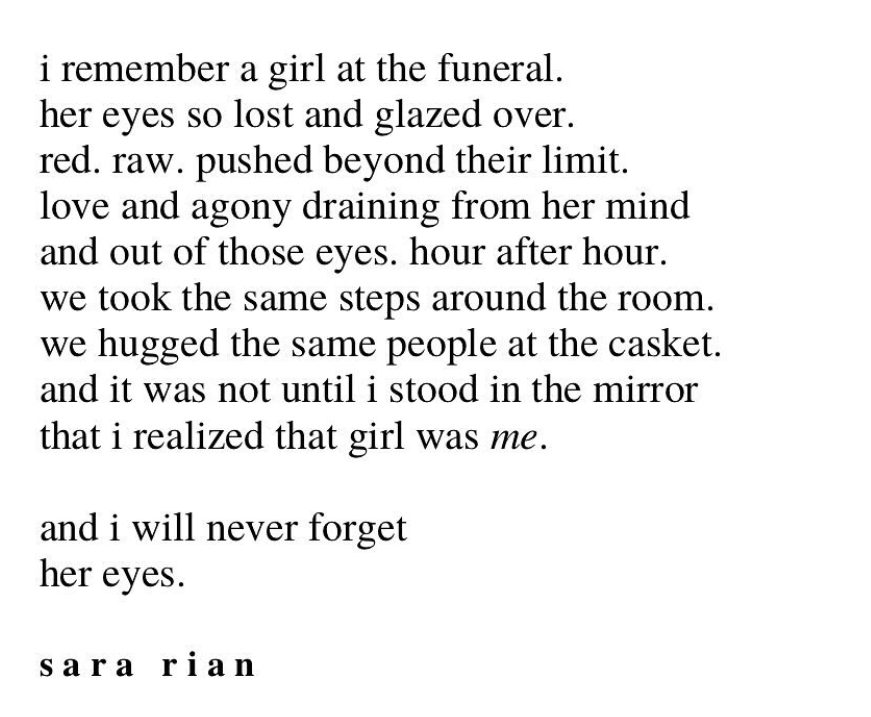
I read this poem, and if you take out the word casket, this is totally me at Tom’s funeral. Her poetry hits bang on so often for me.
I still have times where I know I am not fully present. Times where I just can’t be there. Big things and little things I’m protected from. Like going into the registry to tell them my husband died and I need to change his truck’s registration into my name. My brain offers up hey why don’t you just watch this one? That is going to be hard enough.
Of course it’s not like I just skip these experiences totally and carry-on. They get stored away. In one of her blog posts, New Moon Mira (a widow influencer, if you will) shared a really helpful analogy of trauma. We can think of all our memories and experiences being scribbled down onto a piece of paper. The traumatic ones are written down too, but then scrunched up into a tight ball and thrown way back out of sight.
There was a phase in my grief where shock started to take some longer breaks. I was building a level of connection with Tom in a whole new way. There was one day late in the summer when I arrived at therapy and my counsellor looked at me, “hmm your energy is different today.” And I felt it. It was like a weight had been lifted that day. I carried myself differently. I had actually slept. Like maybe I had found hope on some small level that I was going to make it through this? I was working on understanding how our love still existed in a really different way (the continuing bonds theory in action). Death wasn’t the end of our relationship. I had to figure out what that looked and felt like.
That lightness has certainly not lasted and the sense of hope is not steadfast – but I can come back to it, and I can see that someway and somehow I’ll make it. There’s still a lot of moments now though where it seems to hit like a sledgehammer oh right this is not just temporary. I’ve got to be able to claw back out of that though, not stay too long in the dark.
And it’s not easy. I’m writing this as the one year mark looms, and I definitely wouldn’t say it’s got better. Worse? Don’t do comparisons in grief, the advice goes. Probably shouldn’t do them within my own grief either. The early days were terrible in different ways, yet these days offer up new kinds of battles. The ones that I now realize aren’t temporary, aren’t going away. That Tom died still hits me as a shock, but somehow I’ve made it here. I cannot fathom how.
I don’t run a constant faucet of tears now, so I suppose that is nice. I wear mascara again sometimes, as it’s not guaranteed I’ll be shedding tears out of the blue. I do appreciate that I’m in a space of being able to choose when/where my grief is on display. Recently I’ve pondered if my cognitive function has hit some all-time lows though. I’m on the struggle bus. I wonder if it’s because I’m pushing myself more, out of that initial daze? Trying to make decisions of what comes next? My body is already busy remembering all that happened one year ago? I can’t find words for what I’m trying to get across in a conversation. I try to listen, but only comprehend maybe half of what I am hearing. I like forget to put on deodorant half the time now. (Apologies to the people I’ve seen as a stinky version of me telling you to repeat something over again!)
A big challenge is how much our world expects me to go back to normal. In the early days it was expected I would be a crying, sad widow. But now I should be healed, off you go back to regular life. Obviously I think that is total BS, but at the same time these messages creep inside and do leave self-doubt behind whether I like it or not. My sister said another blog suggestion popped up after reading mine. She clicked to read an article where the author started off saying, “I don’t have much experience with grief,” then finished off suggesting 6-8 months was a reasonable timeline for grief. We now make jokes like, “yeah that only lasts for like 6 months so what could still be bugging you?!” The only thing to do is laugh because of how ridiculous it is.
There is no normal for me to return to – I plan to come back and do another post on this (secondary losses). It is is a whole other level of loss I am just starting to grieve. I feel that this will be a “star of the show” in year two. Life as I knew it has been shattered, and the person I was before Tom died is also no longer there to return to. It’s a layer on top of losing the man I love – it’s also losing the life we had, the life I had, the dreams and plans we had together. That is painful to confront in a whole other way.
Then there’s all the trauma to process, all those little crumpled up papers of memories. Lots of moments I made it through somehow in the past year, but wasn’t actually present to process them at the time. Those stay scrambled around in our minds, hearts, and bodies and can cause all kinds of dysregulation in our systems if we don’t go back to deal with them (… maybe you’d like to read my masters thesis on trauma… just kidding, I believe my grandma was the only person not on my committee to read the entire thing!) Some of these trauma papers I have flattened out, dealt with. But there are many, and some are crumpled tight. It’s going to take a long time to work through those.
The journey continues… one foot in front of the other, one deep breath at a time. Writing this post I was reminded of the quote, “One of the hardest things in life is finding the person you can’t live without, and then being forced to do just that”.


 A Smiling Young Widow
Leave a comment or share your thoughts