
This post has been brewing for awhile as I pondered whether it was something I could actually share. It holds a lot of vulnerable me. My intention with this blog was never to focus on Tom’s death. I want to focus on how he lived life with humour sprinkled throughout, to remember the amazing man and marriage I was lucky to have, to write out stories so they are never forgotten. Read What Happened? (Part 1) for why I feel we need to move away from the default of questioning how someone died.
I know my story of what happened is especially hard to share. It’s an especially cruel way to lose my wonderful husband.
There’s a word that is supposed to describe how Tom died. It has never felt like it fits.
Suicide.
What the fuck.
That was my initial reaction on the phone with Tom’s buddy and holds true to this day. I still struggle with how this can apply to my husband. And I know many others do too. When I had to tell one of his friends the news, I got back a “Tom who?” – it just couldn’t have been this Tom that we were talking about. It makes no sense.
There are what-ifs that come along with any death, but the ones that come after suicide seem infinite. I’ve certainly spent a lot of time trying to make sense of it. Trying to problem solve something that really doesn’t have an answer. I was talking with one of our friends a while back and he asked me, “But there wouldn’t have been a way for Tom to die that would’ve made sense right?” So true. He’d still be dead. There is no sense to be found in death.
As I read more and collect stories, I am cognizant of the silence that surrounds suicide. Suicide is said in hushed tones with such connotations attached to it. Maybe what “we” think of as typical, isn’t actually telling the whole story. I’ve been burned by what others have said to me since Tom’s death (read on). When I wrote about unpacking my trauma experience in safe spaces, well putting this out into the online world doesn’t necessarily feel all that safe and yet I know my words have the potential to help.
Navigating a death that is quickly judged by a misinformed society has been brutal. It’s added another heartbreaking layer on top of the already terrible experience of losing my husband. There is so much judgment, whether it’s something said out loud or it’s an opinion that quietly informs a comment.
It started pretty immediately. I was going to take a walk that first morning to get a break from the ICU. I asked the nurse to make sure my phone number was in Tom’s chart in case anything changed. “Ok, and your relationship is ex-spouse?” Oh. Right. I realized early on that it wouldn’t just be my thoughts running wild on this. The outside world would have all kinds of opinions on what must have happened here, looking to teach me there was something I did or didn’t do and that there was shame to be hiding behind here.
A person’s life is looked at differently based on how they die. I hate that. You can try to tell me no, no that’s not the case. I’ll ask you instead to just hold space to read about some of what I’ve waded through in the past 16 months. Some of which I can totally understand came with good intentions (some not).
Suggesting Tom’s kind nature was a mask…
Tom hated silly small talk, and was really good at connecting with people – he’d have these big heart to heart conversations with someone at a social gathering while I was off talking about the food or something so trivial. He was such a good listener, gave great advice, and looked out for others. He would talk to me about being worried about so-and-so and what they were having to go through. Then after he died I heard comments like, “people are often so much better at talking about other people’s problems than their own”, or, “oh yeah it’s the ones that are always looking out for others”. Please, can we not try to erase what a good friend Tom was. Can we not suggest that he wasn’t actually a caring guy with a heart of gold, that it was just a front.
Or there’s the platitude, “People can keep things hidden so well”… so sorry, to clarify, are you suggesting Tom had all these struggles he wouldn’t talk to me about? That I didn’t actually know my husband? I’m glad that line offers you comfort, but it certainly doesn’t offer any to me. I’ve had to do a lot of work to convince myself that I did actually know my husband as well as I thought. That we did talk through deep things going on with us.
… and even if it was an act to hide behind… people do nice things for others or check-in on friends all the freaking time, and they don’t all end up dead. In fact psychology would tell us that helping others can actually cause positive changes in the brain.
The blame …
Someone told me, “Don’t let anyone tell you people who die this way go to a different place.” Umm yeah I’ve never thought that for a second, but thanks for shoving your beliefs down my throat.
There’s been sympathies of how sorry they are Tom did this to me. I will forever think of this as an accident, as something that happened out of the blue and without a neat storyboard to make sense of. It is something that happened to Tom. It’s not something he did to himself. And he most certainly did not do it to me. He would hate the hurt this caused.
There’s been blame put on me, like something in our relationship led to this. Luckily I haven’t often been outright blamed for this, but yes it happened. Or there was a conversation where someone told me how I couldn’t blame myself because everyone has arguments… uhhh… I understand this was meant to be well-intentioned, but it really speaks to the bias that goes along with suicide. There must have been an explosive fight, right? Probably a controlling wife? Stories people weave to make sense of something like this. I’ve struggled enough with my own brain looking to make up an explanation, I certainly don’t need anyone else’s imagination in the mix. Nope, we didn’t have a fight. Nope, we weren’t miserable together.
… and even if we had a fight or had been in a rough patch, people have terrible interactions with others all the time and stay alive. We also don’t have that kind of power over others, we are not capable of determining whether someone else lives or dies. If you do still want to try and say that this is something someone consciously does… no one would ever make the decision to end their own life lightly.
Talking about alcohol or other problems…
Yes, Tom had been drinking that night. I absolutely believe that played a role in what happened in his brain. But no, Tom did not have a drinking problem (I have been asked since he died). He drank casually, similar to most people I know in my life and less than a lot of people he knew in his life.
There’s been hints at addiction, gambling, losing a job, or financial ruin being a part of this (some of these actually came up as I tried to find a psychologist). All was good. We had a great future ahead, Tom was planning for that right along next to me. I do understand where this questioning comes from as again, the narrative we’re taught says there must have been a breaking point or something that was in disarray. Trust me when I say there wasn’t one — I’ve spent so much time combing through everything trying to find one I missed.
… and even if someone is struggling with alcohol or another addiction, people can live with addictions for a very long time or they can recover. People drink themselves black-out drunk and wake up the next morning. Substance use is not an easy X leads to Y story. And I feel really passionately that we should not define anyone by an addiction – that should not be the part of a person or their life that anyone focuses on, there’s a whole person there.
Weaving a story of mental health struggles…
Society offers the phrase that someone “lost their battle with mental illness” as a soft way to describe suicide. I don’t believe we had the chance to battle this. I would have loved if those typical warning signs were present and I could have caught this. Friends, I’ve done the suicide prevention trainings and mental health first aid courses. I know the signs I was supposed to watch for and the questions I was supposed to ask. I never got the chance.
We are in the very infancy of what we understand about suicide. Absolutely I’ll acknowledge there must have been some deep pain, but I truly believe something just snapped that night. It really was so sudden. Maybe there was something going on in Tom’s brain at a structural or chemical level. Maybe neurobiology will one day help us to understand this a bit more (there are studies going on). Don’t you dare try to tell me this was rational thought though. I know enough about the brain, my Tom, and what else happened that day to dispute that.
I’m honestly cynical about suicide prevention campaigns now, though I’m torn as I do know they have their place. I’ve seen them work in some instances… But I also don’t think they can possibly apply to all suicides. It’s like there’s different types. And what disservice is this messaging doing for those of us left behind grappling with losing a loved one to suicide?
Already rattled with guilt and ransacking my memories for anything I might have missed, I remember very early after Tom died deep diving into google. I found myself reading a suicide prevention poster that told me, “100% of suicides can be prevented’? I swore out loud and slammed my laptop shut. What am I supposed to think reading that after my own husband has just died from suicide?
I stumbled onto an article looking at how fast people seemed to have “decided” to kill themselves. A quarter of people interviewed said there was under 5 minutes between the time they decided to and when they actually did attempt suicide. Minutes. Seconds. (I personally still can’t use the word decided, as to me it implies a level of rational thought. I also struggle with how we, obviously, only have research from people who don’t actually die from suicide – but that’s a whole other conversation.)
My friend Trina wrote an amazing, heart-wrenching piece in the The Times on shame and suicide after she lost her brother. Highly recommend reading it.
It’s as if we’re taught you either have mental health or you don’t. False. Tom had a lot of healthy coping mechanisms in his toolbox and he did a lot of things that are really good for mental health. Maybe not enough? He didn’t see a psychologist or counsellor. People have asked me that and then wondered if I think that would’ve helped and like gosh, of course I wish he had so I could check another box of what-ifs I shouldn’t be stuck on. But I honestly don’t know if that would’ve helped, especially since I’ve now seen a sleuth of unhelpful mental health professionals since Tom died. Plus when I wrack my brain over and over again for something I missed in one of our deep conversations, I actually can be quite sure he didn’t know this was looming like this either (That’s when I’m able to turn off all the self-doubt that has seeped in after he died, remind myself how well I did know my husband at his core and that our deep authentic connection really did exist.)
One of things I reallyyy struggle with is the idea that Tom is now supposed to be an example of why we need to take care of our mental health. For sure, let’s all do that. Reach out to your people, check-in on them and have real conversations. Tom was great at that, so can we maybe do it in his honor? Rather than as some prevention thing that was missed? Let’s take care of mental health, not just to prevent death, but rather because it makes for a better experience in this ol life when we can build as much health of all kinds.
… and even if there was mental illness, people battle mental illnesses all the time (they are much more common than we seem to think). These people are not all dying. Just like we can manage or overcome a physical illness, we can also do that with mental illness. Or people can live a long time without managing a mental illness. People also can struggle with really poor mental health or lack coping skills and still make it in this world. Again, sorry to blow-up the expectation that everything can be predicted here.
I do get how this might all read to someone who hasn’t gone through anything similar. I didn’t write this trying to convince anyone. There’s the otherizing I talked about in Part 1 – this is terrible so it totally makes sense the brain would try to protect anyone from this being a possibility in their own circle. Honestly maybe I still would have thought the same way reading through this– figured there was still something that was missed and there had to be some explanation. Except now I had to experience this happening to the one person in this world I felt I knew at his core. I was truly blindsided.
I’ve come a long way on this grief journey. I’ve learnt that it is ok to protect me, not everyone needs to be let in. I do really believe we need to train out that immediate “what happened?” response when we hear about a death. I love to share about how Tom lived, I don’t want the focus to be on a final few minutes at the end.
“Sometimes when I tell somebody about what happened they ask, ‘Were you close?’ And I don’t really know how to answer that question. I mean, I used to think so… before.”
– A quote from Anderson Cooper’s podcast where he talks about his brother dying from suicide. Powerful. It is really worth a listen.
We are told suicide can be prevented, we really want to believe we can protect ourselves and our people. I am sorry that isn’t always the case. My views on that have drastically changed, and it comes through in how I worry about SO many people in my life now. I could not have predicted Tom dying this way and I worry about how this could happen to others too.
My writing is a bit flippant about the comments I have fought to not internalize since Tom died, but these things have cut deep. I have never once, not even for an instant, had a glimmer of shame about being with Tom. I will forever be proud to be Tom’s wife. I love when there’s a situation where I still get introduced as Tom’s wife. But why have I felt the need to put on some weird armor to defend my man and our relationship? To defend me? Is it the comments from the periphery? Is it because of how society had taught me to think about suicide too?
The one person who could truly reassure me, well I can’t just call him up anymore. But I can imagine what he would say. Very early on I could hear Tom’s no nonsense voice in my head telling me that anyone who could think, even for a second, that this was something I did or didn’t do, well they didn’t know us at all.
I feel I need to acknowledge that there have been so many supportive people in my life too. Like the people whose first instinct when they heard was to tell me how they knew I meant the world to Tom. Or the people who have just held space for how terrible this is, rather than trying to fit it into some narrative that can be explained. If only the brain would focus on the positive stuff hey? Why couldn’t those comments have been the ones I’d catch looping in my brain?
Unfortunately it’s not as easy as just telling yourself to believe the rational thoughts. The doubts creep in. The body runs with it. People’s comments could reignite my smouldering what-ifs all over again. They could hit my weak spots, pieces I still went back to over and over again as I wondered if there were moments I should have read into more or conversations I would’ve/could’ve worded differently. At a deep level I believed I should have had some superpower to prevent this. It wasn’t until this past month with EMDR therapy that I had a breakthrough of letting go of some of that deep guilt. I hope that lasts.
Here’s what I’ll wrap up with:
Tom was an amazing person. We were amazing together. It wasn’t perfect, but it was perfect for us (another post coming on that). I’m going to go ahead and not be humble right now – our relationship, the way we treated each other, who we became as individuals, the life we had crafted together was all amazing too. Yet, society and our suicide narrative still told me that I had missed something. There was something we’d done wrong. I’ve been made to feel like I didn’t actually know my husband, or that I should question everything I thought I knew about our relationship. I can only just begin to imagine how painful it would be to navigate the judgment and blame if there had been stormier seas to look back on.
I wasn’t sure I’d ever put a blog post like this out, but I think it’s needed. I did not write this for pity or apologies, I truly do not want those messages. I hope to shed some light and build awareness. If my writing can end up offering the slightest comfort, whether directly or indirectly, to anyone else trying to navigate how to possibly move forward after suicide, then it’s worth putting these words out there.
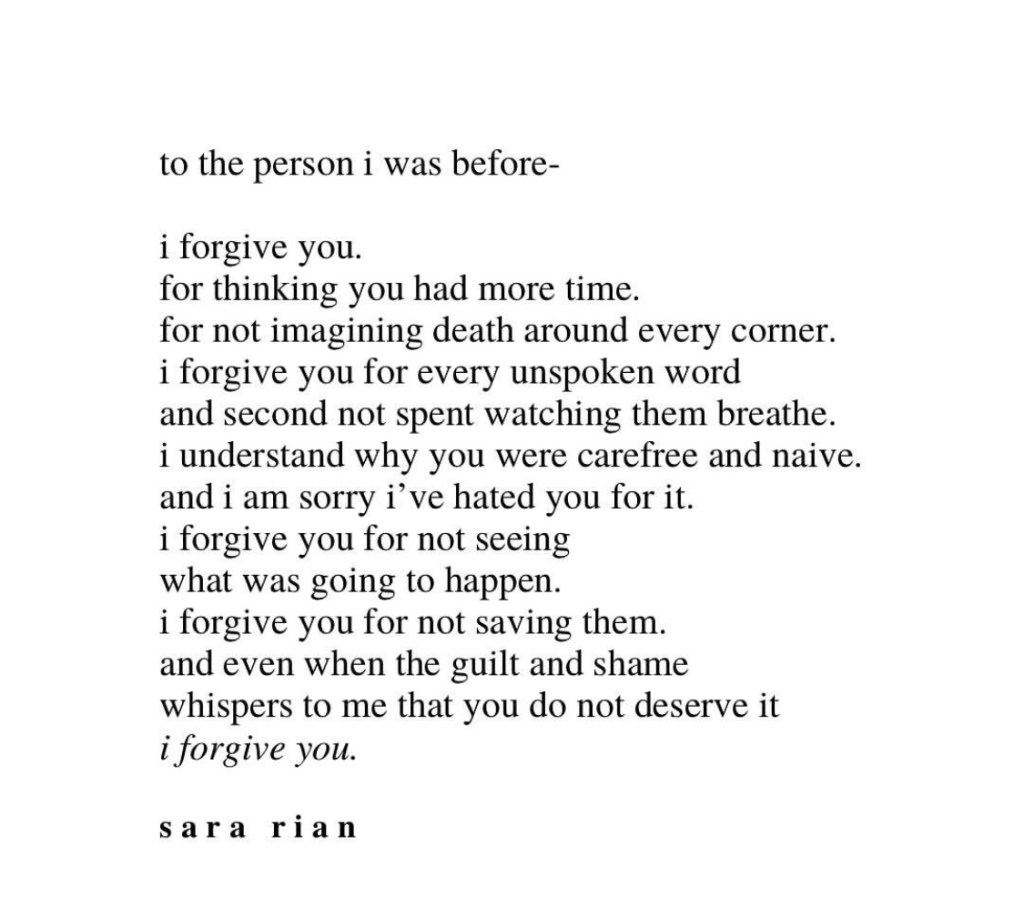
If you are struggling with thoughts of suicide please know no matter the dark place you find yourself in, there absolutely are people that care deeply about you and would do anything humanly possible to help keep you here. Tell someone. We have an easy to remember hotline in Canada now too, 988.


 A Smiling Young Widow
Leave a comment or share your thoughts