
I’m going to share a bit about my favourite grief theory (kind of crazy that I have a favourite grief theory, hey?) – it’s called the continuing bonds theory.
Here is a quick overview I’m taking word-for-word from this website: When your loved one dies, grief isn’t about working through a linear process that ends with ‘acceptance’ or a ‘new life’ where you have moved on or compartmentalized your loved one’s memory. Rather, when a loved one dies you slowly find ways to adjust and redefine your relationship with that person, allowing for a continued bond with that person that will endure, in different ways and to varying degrees, throughout your life. This relationship is not unhealthy, nor does it mean you are not grieving in a normal way. Instead, the continuing bonds theory suggests that this is not only normal and healthy, but that an important part of grief is continuing ties to loved ones in this way. Rather than assuming detachment as a normal grief response, continuing bonds considers natural human attachment even in death.
(I actually found a couple systematic reviews on continuing bonds, if you really want to delve in you can read those here and here. Full disclosure I only skimmed these, the ol grieving brain and limited cognition this last little bit doesn’t exactly lead itself to wanting to focus on academic reading.)
To me this theory boils down to – death ends a life, not a relationship. It’s been so helpful for me to lean into that idea. I also want to keep it real, nothing takes away the pain or fixes grief. Kind of like the platitudes where someone would say, “oh but they are always with you”, or, “they live on in our memories”. It’s not enough. I still want the real human Tom here. Our society wants to believe that leaning on love is some magical medicine that will fix things. But love supports us, it doesn’t take away the pain.
I joined a workshop a while ago all about continuing bonds (here’s a link to the facilitator Marie-Clare’s instagram). One line that stuck with me, if you can’t live without him… well don’t. The grief world used to be all about moving on and cutting ties. Continuing bonds is the opposite. In the workshop Marie-Clare explored the theory in three different ways: spiritual, imprint, and ongoing resource.
Spiritual Connection:
The theory doesn’t necessarily have to be spiritual if that’s not for you, though I think it would be rare for someone to go through a huge loss and not massively reevaluate anything they ever thought they believed.
I’ll just go full research mode here and quote straight from the one article: “A qualitative study found that female participants and those who had a close pre-death relationship with the deceased family member or partner had more spiritual experiences with the deceased.” Oh that’s me! But you do you, I think it’s whatever gives each of us comfort. Interestingly in the other journal article they talk about social stigma being a big thing – people were careful who they shared about believing in continuing bonds with.
To me this piece of the continuing bonds theory also speaks to the “unfinished business” when someone dies. I had no idea this was coming, it hit without warning and death is unfortunately very final. I think looking back, this is where continuing bonds was the most helpful for me – I had to believe my leftover words could go somewhere or play some purpose. There were loose ends I needed to believe could somewhat get wrapped up if I was going to be able to move forward at all. It can be journaling for yourself or to your person, texting a number that isn’t going anywhere, recording voice notes, talking out loud to your person, or making art that moves all the swirling thoughts out. It’s never the same, but it can help.
Imprint: Our People Change Us
We are forever changed by the love and relationship we had with our people. That doesn’t go away when someone important dies. This can be reflecting on how your loved one changed who you became as a person, the lessons they taught you, the core values or traits you now embody. You can even be super science minded and acknowledge the epigenetic side of how people we are close with literally change us.
Marie-Clare suggested asking the question, “Who am I because of you?”
Especially with a spouse, we share values with someone we share a life with. This is such a basic idea, but it was an a-ha moment for me. There was a point last fall where my psychologist suggested that we could do some work on understanding my values as a way to move forward. At first I thought yes, great idea. I wanted something to do or a plan to follow so I could figure out what to do with myself. Then as I thought about it more, it didn’t feel right or like something I wanted to work on. I was digging my heels in. Listening to this workshop helped make sense of this. Tom and I shared our values, and I still want that. A lot of the work of really uncovering those values was done together, figuring out what we wanted and living like that. We had made some good changes together. See the problem is, I was pretty much living the life I wanted. Of course I, like so many others, questioned things like whether I actually wanted to do the job I was in or if we were meant to live where we were or what our future would look like. (Wish I could go back in time to just be grateful for it all just as it was.)
Then there are some values your person holds closer to their core or things they were better at. We can keep those alive. Choose the best parts of our person to carry forward. This could also be legacy projects – to me that can sound super intimidating, so it’s good to remember these can be small, like cooking a favourite dish or bringing them up in a conversation or enjoying an activity the person liked. I think of this when I get out on my mountain bike – last year was hard and I didn’t ride much, but I wouldn’t have mountain biked if it wasn’t for Tom.
Whether I like it or not, my life is now a legacy to Tom. That’s the new chapter of the Tom and Les story. In the workshop, Marie-Clare shared how she think of all of her work now, from people reading her instagram posts to connecting with her online or one-on-one, becoming a part of her late husband’s legacy. That is pretty beautiful. A few people have told me how they now use some of the Tom-isms I’ve shared on this blog, it’s heartwarming to know those pieces of my guy are staying alive.
Ongoing Resource:
The continuing bonds theory can also be thought of as a tool or a resource for coping as we try to move forward. What happens next becomes a way to honour our relationship, but it also can continue to offer strength. I like to think of it as an anchor. This journey gets overwhelming often and I need this idea to come back to, something to ground me.
I still find strength from Tom. I still take guidance from Tom. I desperately wish for a real conversation again, even in a dream, though I also know I know what he would say to me most times. What his opinion would be. What he’d be chuckling away at. Sometimes when we were out for dinner or a drink, we’d look at the menu and say what we thought the other would be ordering. Got to know each other pretty darn well. So if I can still imagine what Tom would order at a restaurant, it makes sense that I can also predict what he’d say to me in most situations. It’s something I try to lean into. Part of the losses that need to be confronted in widowhood is losing your sounding board, voice of reason, and shared decision-making.
Then there’s the huge void left without your person’s unconditional love and support. You get used to having that. It’s a challenge to carry-on loving myself like Tom did. Continuing bonds can be a tool for self-care, trying to bring some of the love back to yourself – thinking about how your person would see you now and what they would be proud of. That’s always there to tap into.
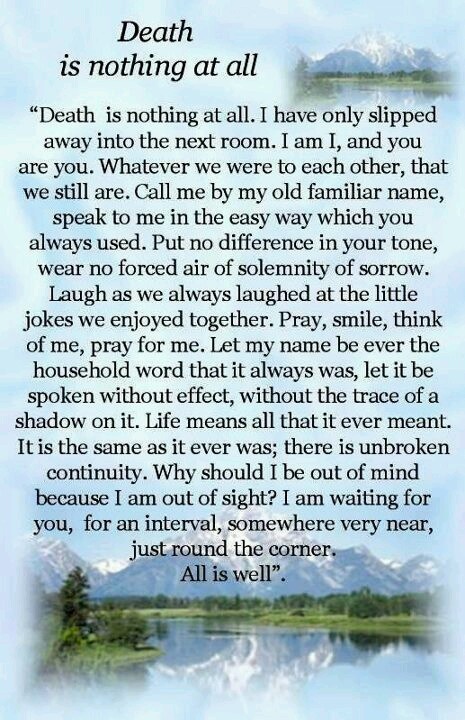
I’ll finish with a poem we shared at Tom’s funeral – Death is Nothing at All.
I think it means even more to me now.


 A Smiling Young Widow
Leave a reply to Leslie Cancel reply